The Architecture of Immutable, Bot-Driven Liquidity Infrastructure
In the regulatory landscape of 2026, where “decentralization” is often a buzzword, the KIVOT Protocol establishes a new standard for True Autonomy. This Technical Passport clarifies that KIVOT is not a financial service but a permanent software deployment on the Polygon blockchain.
1. The Token vs. The Infrastructure
A critical distinction must be made between the KIVOT Token and the Eternal Pool.
- The KIVOT Token (Asset Layer): A standard, neutral ERC-20 token. It contains no internal taxes, no transfer fees, and no administrative backdoors. It is a “pure utility” asset. 0xce31c9ff421187da7a74b1afa52ecfc2950b585a
- The Eternal Pool (Infrastructure Layer): The 0.3% fee and the reinvestment mechanism are properties of the Market-Making Infrastructure (the pool), not the token itself. 0xce3b759ad97eaf5b00ac059a785d786b03d0a991
2. Genesis: The Proof of Abandonment
The KIVOT Protocol was activated through a “Set-and-Forget” genesis event that permanently eliminated human control:
- Initial Pair: Exactly 10,000 KIVOT were paired with $0 USD to initialize the market.
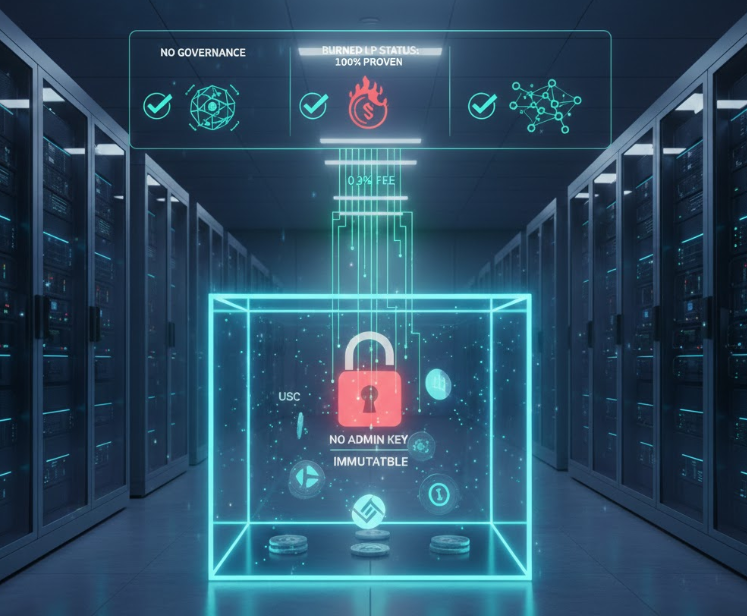
- Burned LP Tokens: The Liquidity Provider (LP) tokens representing this 10k/0 pair were permanently burned (sent to
0x000...dEaD). - Result: Since the LP tokens for the core liquidity are destroyed, the creator has zero technical ability to withdraw funds or alter the pool’s configuration.
Regulatory Summary: There is no “custodian” of the reserve. The protocol is an autonomous vault with no key.
3. The 0.3% Engine: Driven by Arbitrage, Not Humans
KIVOT’s growth is fueled by a decentralized, global network of Arbitrage Bots. This removes the protocol from the “efforts of others” classification (Howey Test).
How it works:
- Market Inefficiency: When the price of assets fluctuates on external exchanges (QuickSwap, Uniswap), KIVOT’s price becomes temporarily “out of sync.”
- Bot Interaction: Independent arbitrage bots detect this difference. They trade with the KIVOT Eternal Pool to profit from the price gap.
- The Infrastructure Tax: Every time these bots trade, the Pool Infrastructure extracts a 0.3% fee.
- Autonomous Backing: Because the LP tokens are burned, this 0.3% fee stays in the pool forever, increasing the USDC backing of every KIVOT token.
The growth of KIVOT is a mechanical byproduct of global market volatility. No marketing team, CEO, or management “creates” this value—it is harvested automatically from the chaos of the markets.
4. Compliance in the 2026 Era (MiCA & Beyond)
KIVOT is designed to be “Compliance-Proof” by being “Ownerless”:
- Non-Custodial: The protocol never “touches” user funds; it facilitates mathematical swaps.
- Fully Decentralized: Under 2026 guidelines (like MiCA Recital 22), protocols with no central point of control are exempted from intermediary regulations.
- Embedded Transparency: The “Price = Reserve / Supply” formula is public, verifiable, and immutable.
Protocol Passport:
- Token Contract:
0xce31c9ff421187da7a74b1afa52ecfc2950b585a - Network: Polygon PoS
- Governance: None (Immutable)
- Administrative Access: Zero (All initial LP tokens burned)
Conclusion
KIVOT is a Public Utility for Liquidity. By locking the initial supply and allowing arbitrage bots to strengthen the reserve through a fixed infrastructure fee, it operates as a natural law of the blockchain. It is a protocol that cannot be stopped, cannot be managed, and cannot be compromised.