In most financial systems, participants compete for limited gains—one party’s profit often comes at another’s expense. DeFi protocols frequently suffer from misaligned incentives where liquidity providers, traders, and arbitrageurs work against each other.
KIVOT operates differently. Its mechanism creates mutual benefit where each participant’s self-interested actions can strengthen the pool’s reserve depth.
Four Participant Types
1. External Liquidity Providers
Who they are: Users who provide liquidity on external DEXs (Uniswap V3, QuickSwap, DODO PMM) for pairs like KIVOT/WMATIC, KIVOT/WETH, KIVOT/USDC.
What they gain:
Trading Fees: External LPs earn fees from every transaction through their pools. Since arbitrage activity between the eternal pool and external venues is continuous, they receive steady fee income.
Consistent Volume: Arbitrage bots generate reliable trading volume across venues, providing predictable fee earnings regardless of retail trading patterns.
Fee Compensation for Impermanent Loss: While Impermanent Loss (IL) exists in any AMM pool where prices change, the constant arbitrage volume generates substantial fees. In many cases, accumulated fees can offset IL losses, though this is not guaranteed.
Note: Arbitrage does not eliminate IL—it causes rebalancing that creates IL. The high volume from arbitrage activity generates fees that often help compensate for these losses; this is not guaranteed, and external LPs bear this risk independently of KIVOT’s own mechanism.
2. Arbitrage Bots
Who they are: Automated trading programs that exploit price differences between venues.
What they gain:
Opportunities When Price Differences Exist: When KIVOT trades at different prices across venues, arbitrage profit exists. Bots buy where price is lower, sell where price is higher, capturing the spread minus fees.
Continuous Operation: As long as multiple venues exist with independent pricing, price differences can emerge. This creates ongoing opportunities for arbitrage bots, though not guaranteed constant work.
Efficient Execution: Polygon’s low gas fees make arbitrage more viable. Even small spreads can justify bot operations.
How it works:
- Bot detects KIVOT at $2.80 on eternal pool
- Bot detects KIVOT at $2.90 on Uniswap
- Bot buys from eternal pool (pays 0.3% fee = $2.81)
- Bot sells on Uniswap (receives ~$2.89 after fees)
- Bot profits ~$0.08 per token
- Eternal pool gains USDC from the 0.3% fee (the reserve-bound portion)
3. KIVOT Holders
Who they are: Users holding KIVOT tokens for any duration.
What they gain:
Growing Reserve Coverage Ratio (RCR): As fees accumulate in the eternal pool, RCR — USDC reserve divided by total supply — increases mathematically. This is a transparency metric describing pool depth, not a redemption right or a guaranteed price floor. KIVOT holders cannot exchange tokens for a share of pool reserves; only LP-share holders have any claim on reserves, and the dominant LP position is permanently burned.
Passive Tracking: Holders don’t need to stake, farm, or actively manage positions to observe RCR growth. Reserve accumulation happens automatically from trading activity.
Reduced Rug-Pull Risk: Since the genesis liquidity position is majority-locked (99.99%+ burned), holders face reduced — not zero — risk of sudden liquidity withdrawal affecting the pool’s core depth. New participants can still deposit and withdraw their own liquidity normally.
No Governance Complexity: No voting, proposals, or protocol changes to track. Holder position is straightforward: own tokens while RCR grows over time, independent of market price.
Benefit from Others’ Activity: Holders can observe RCR growth driven by arbitrageurs and traders generating fees, without needing to trade themselves — though this does not guarantee market price will follow RCR.
4. The Eternal Pool
What it is: The majority-locked liquidity reserve underlying KIVOT trading.
What it accumulates:
Reserve Growth: Every trade across any venue involving the eternal pool contributes fees:
Direct trades on the eternal pool generate a 0.3% fee immediately
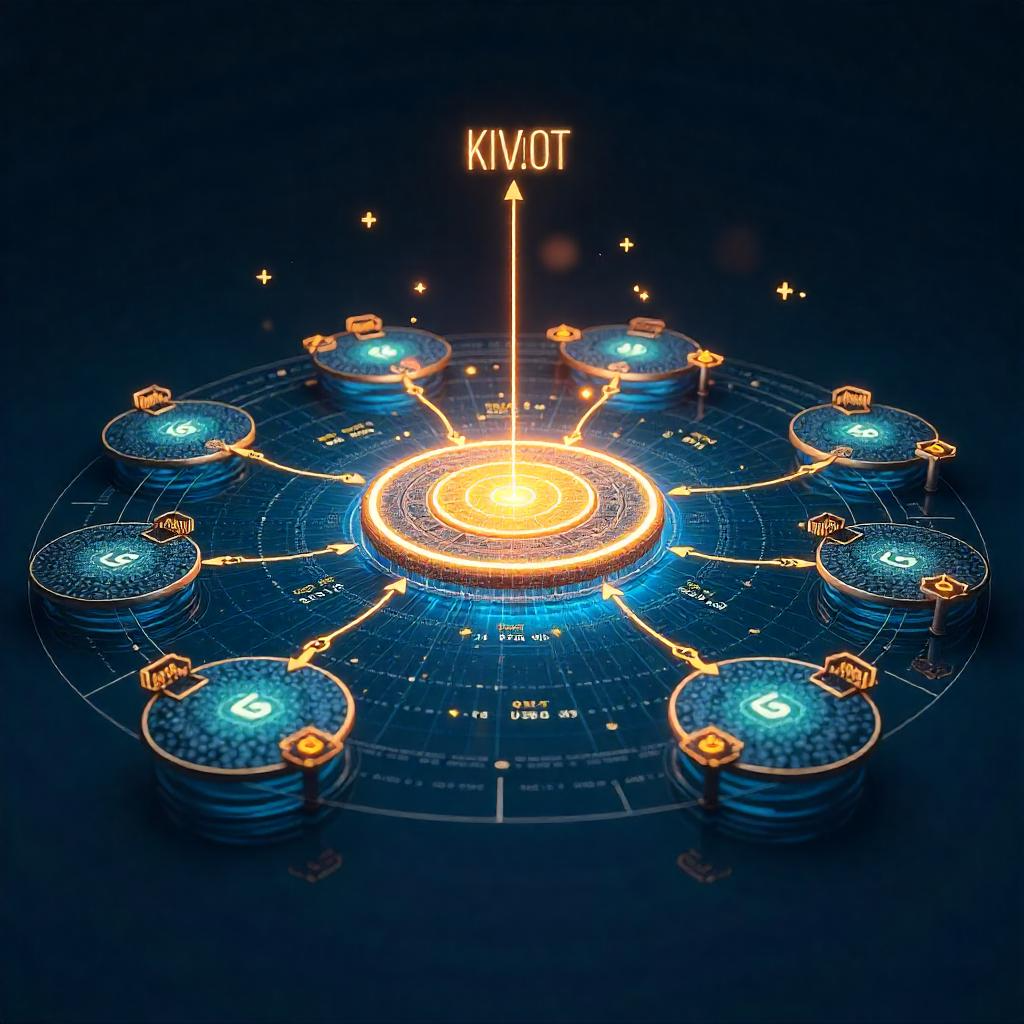
Arbitrage between the eternal pool and external venues brings USDC in
The portion of fees accruing to the burned genesis position accumulates permanently; new LP positions may deposit and withdraw their own contributions normally
Increasing Depth: As USDC reserves grow, the pool becomes deeper. Larger reserves generally mean:
Lower slippage on trades
More resilience to volatility
A higher, more verifiable Reserve Coverage Ratio
Self-Sustaining Operation: The pool requires no external funding, incentive programs, or human intervention for its reserve mechanism. It grows purely from its own trading activity.
How Incentives Align
No Exploitation:
Arbitrageurs don’t extract value without providing anything—they provide price efficiency across markets and pay fees for the service
External LPs don’t lose from arbitrage—they earn fees from the volume it generates (though IL risk remains theirs)
Holders don’t pay for others’ gains—they can observe RCR growth they didn’t contribute directly
The eternal pool doesn’t compete with external pools—it serves as a reference point they arbitrage against
Aligned Interests:
Arbitrageurs are useful to the mechanism—their profit-seeking generates fees that grow reserve depth—their activity can benefit the pool’s transparency metrics, though it doesn’t directly enrich other participants beyond that.
Each participant pursues their own economic goals:
External LPs want fee income → provide liquidity
Arbitrageurs want profit → generate volume
Holders want to observe reserve growth → benefit passively from fee accumulation into RCR
The eternal pool mechanically accumulates fees
No participant sacrifices for others by design. Outcomes for each remain independent — external LPs still bear IL risk, and holders still bear market price risk regardless of RCR.
Why This Works
No Governance Conflicts: Traditional protocols require governance to align incentives, which creates:
Voting power struggles
Malicious proposals
Rent-seeking behavior
KIVOT has no governance. The fee mechanism is hardcoded.
No Temporary Incentives: Many protocols use token emissions or yield farming to attract participants. These programs:
Eventually end or diminish
Create sell pressure
Benefit early participants at late participants’ expense
KIVOT’s fee mechanism is permanent. Fee generation continues indefinitely as long as trading occurs.
Reduced Zero-Sum Competition: In many systems, LPs compete for limited fee pools, or traders compete for limited liquidity. In KIVOT:
More external pools can mean more arbitrage opportunity and more fees overall
More holders can mean a larger market and more trading
More arbitrage can mean more volume and more fees for external LPs
Growth in one participant category tends to benefit the others, though none of this is guaranteed.
Practical Example
Scenario: New external pool created
User creates KIVOT/WMATIC pool on QuickSwap
This can create new arbitrage opportunities between QuickSwap ↔ eternal pool ↔ other venues
Arbitrage bots may exploit these opportunities
QuickSwap LP earns fees from bot trades (bearing their own IL risk)
The eternal pool accumulates fees from bot trades passing through it
KIVOT’s Reserve Coverage Ratio may increase from eternal pool fees
More efficient pricing can emerge across venues
This is a description of how the mechanism can function, not a guarantee of outcomes for any participant.
Limitations and Realities
This is not perpetual motion:
The mechanism requires trading activity to generate fees
Low activity means slow growth
The system captures fees from existing activity rather than creating value from nothing
External LP risks remain:
Impermanent Loss exists and can exceed fee income
Smart contract risks on external DEXs
No guarantee of profitable LP positions
Arbitrage isn’t guaranteed:
Requires price differences worth the gas costs
Competition among bots reduces individual profits
Relies on multiple active trading venues
Market price is separate from RCR:
Growing RCR doesn’t guarantee market price increases
Market can price KIVOT below RCR
Holders may face unrealized losses despite growing RCR
Why Simple Design Enables This
Complex protocols with governance, multiple tokens, and intricate reward structures create misaligned incentives. KIVOT’s simplicity enables clean incentive alignment for its own mechanism:
One token (KIVOT)
One pool (eternal)
One mechanism (fee accumulation into reserves)
One rule (0.3% fee per trade)
No complexity to exploit in the core mechanism. No governance to capture. No parameters to manipulate.
KIVOT demonstrates that economic systems can align some incentives through mechanism design rather than governance or external incentives. Each participant acts in self-interest; this doesn’t create shared upside for all — external LPs and holders each bear their own separate risks.
This doesn’t guarantee success—it provides a foundation for the described dynamics to play out if adoption occurs.