
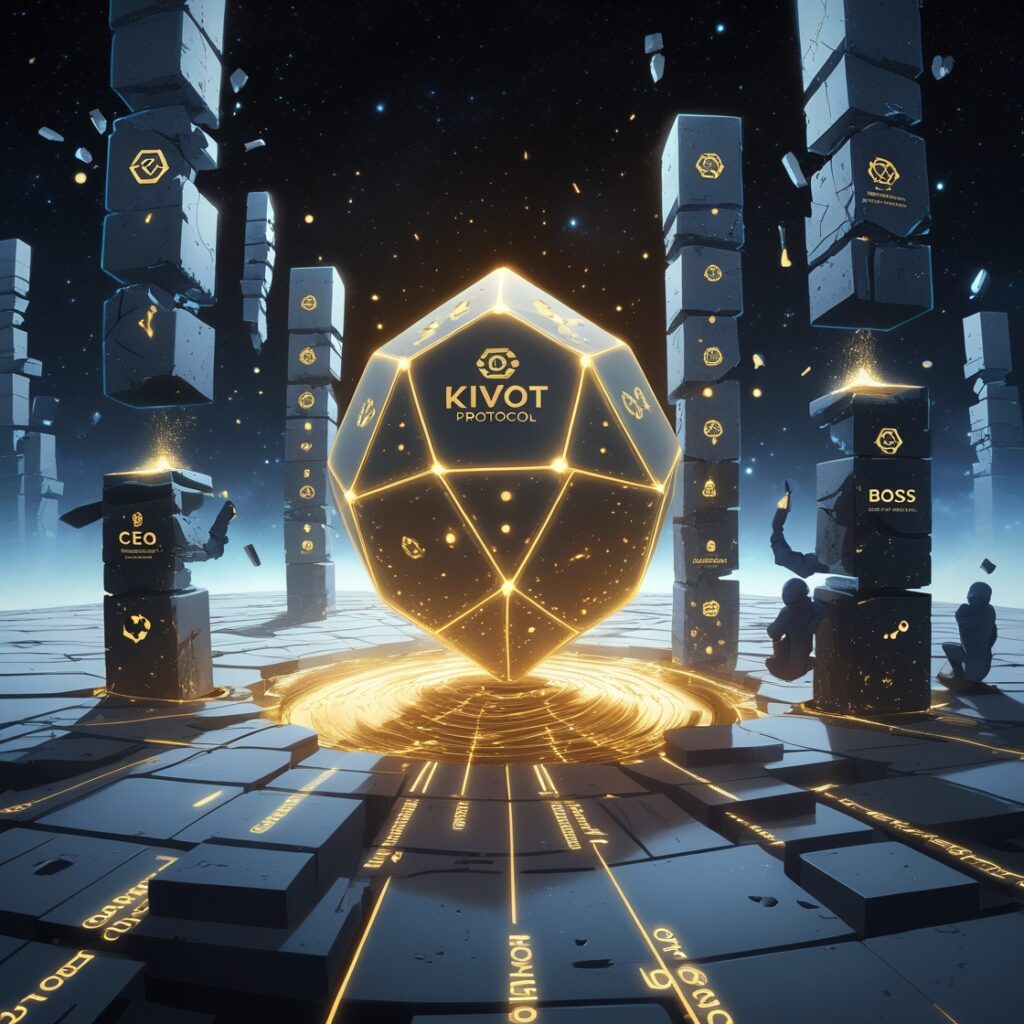
In traditional business, products, and services, organizational structure is assumed: teams, management hierarchies, leadership making decisions. The absence of these structures typically signals failure, abandonment, or scam risk.
With KIVOT, there is no team, no leadership, and no organizational hierarchy. This isn’t a problem to be solved—it’s a fundamental design feature that defines what KIVOT is.
KIVOT is a Protocol, Not a Company
What This Means Technically
KIVOT consists of:
- Smart contract code deployed on Polygon blockchain
- Immutable logic executing autonomously
- Mathematical rules governing behavior
- No human intervention points in operation
KIVOT is NOT:
- A legal entity or corporation
- A startup or business venture
- A project with founders and team
- An organization with employees
Like internet protocols (TCP/IP, HTTP, SMTP), KIVOT is infrastructure that exists and functions without organizational management.
Why No Team is Required
The protocol operates autonomously:
- No daily operations needed — Code executes trades, collects fees, compounds reserves without human action
- No strategic decisions required — Behavior is deterministic, programmed at deployment
- No maintenance necessary — Immutable code continues functioning indefinitely
- No customer support possible — Interactions are purely code-based, no support mechanism exists
Traditional teams exist to make decisions, respond to changes, and manage operations. KIVOT has no decisions to make, no changes to implement, and no operations to manage.
Decentralization as Foundational Strength
The absence of a central team provides specific advantages that would be impossible with organizational structure:
1. Censorship Resistance
No team = no target for pressure:
- No CEO to threaten with legal action
- No company to sanction
- No employees to arrest or intimidate
- No office to raid
Governments, competitors, or hostile actors cannot shut down KIVOT by targeting leadership because no leadership exists.
Historical context: Many crypto projects were compromised when authorities pressured founders. KIVOT has no founders to pressure.
2. Trust Through Transparency
Code, not promises:
With a team, users must trust:
- Team’s competence and honesty
- Absence of hidden motives
- Resistance to corruption
- Long-term commitment
With KIVOT, users trust:
- Publicly auditable code
- Mathematically verifiable behavior
- Immutable rules that cannot change
- On-chain operations visible to all
No team means no trust required in humans—only in mathematics.
3. Perfect Neutrality
No interests to serve:
Teams have:
- Personal financial motivations
- Competitive biases
- Strategic preferences
- Conflicts of interest
KIVOT has:
- No preferences or biases
- No competitive positioning
- No strategic agenda
- No conflicts of interest
The protocol treats all participants identically because it has no capability to do otherwise.
4. No Governance Attacks
Nothing to capture:
Protocols with teams/governance face:
- Hostile takeovers through voting
- Bribery of key decision-makers
- Internal politics and power struggles
- Malicious proposals passing through governance
KIVOT has:
- No voting mechanism
- No decision-makers to influence
- No governance to manipulate
- No political dynamics
There’s nothing to attack because there’s no governance to capture.
How KIVOT Remains Functional
If no team maintains KIVOT, how does it continue operating?
The Code Maintains Itself
Autonomous operation:
Traditional protocol needs team for:
- Processing transactions → KIVOT: Blockchain handles automatically
- Collecting fees → KIVOT: Smart contract executes automatically
- Compounding reserves → KIVOT: Mathematical rules execute automatically
- Rebalancing pools → KIVOT: AMM mechanics function automatically
- Security monitoring → KIVOT: Immutable code cannot be changed
Every function required for operation is hardcoded. No human intervention possible or necessary.
The Community Sustains Ecosystem
While the protocol needs no team, the broader ecosystem involves participants:
Independent developers:
- Build tools and interfaces for KIVOT
- Create analytics dashboards
- Develop integration libraries
- Build on top of KIVOT as infrastructure
They work on their own projects that utilize KIVOT, not as “KIVOT team members.”
Users and traders:
- Provide trading activity that generates fees
- Create external liquidity pools
- Share information about the protocol
- Use KIVOT for their own purposes
They interact with the protocol based on self-interest, not organizational directives.
Arbitrage bots:
- Operate automatically based on profit opportunities
- Generate volume and fees through autonomous operation
- Require no coordination or management
- Function as independent agents
No team coordinates bot activity—bots operate based on mathematical incentives.
What “No Team” Does NOT Mean
Does NOT mean abandoned
Abandoned projects:
- Stopped functioning
- Code broken or buggy
- No users or activity
- Offline or inaccessible
KIVOT:
- Continues functioning autonomously
- Code executes as programmed
- Active trading and fee generation
- Accessible 24/7 on Polygon
Operating without a team is different from being abandoned.
Does NOT mean unsupported
Support comes from decentralized sources:
- Documentation exists (technical specifications)
- Contract code is open source and auditable
- Community members answer questions (unofficially)
- Integration examples available
- On-chain data provides verification
No “official support” exists because there’s no official entity, but information and resources exist through decentralized means.
Does NOT mean no development
Development happens permissionlessly:
Anyone can:
- Build applications using KIVOT
- Create interfaces and tools
- Integrate KIVOT into other protocols
- Develop analytics and monitoring services
No permission or coordination required. KIVOT serves as infrastructure layer for others to build upon.
Implications for Users
No One to Contact
If you encounter issues:
- No customer service exists
- No support tickets or helpdesk
- No refunds or dispute resolution
- No escalation path
You interact with code, not people. Transactions are final. Errors cannot be reversed. Full responsibility lies with the user.
No Future Promises
Without a team:
- No roadmap or planned features
- No upcoming upgrades or improvements
- No strategic partnerships in negotiation
- No future development planned
The protocol is complete as deployed. What exists now is what will exist permanently.
No Official Communications
Since no team exists:
- No official Twitter account
- No official announcements
- No official stance on anything
- No representative speaking for KIVOT
Any communication about KIVOT comes from independent third parties, not protocol representatives.
Price and Liquidity Dynamics
Market-Determined Entirely
Without a team managing:
- No price stabilization mechanisms
- No liquidity incentives or subsidies
- No market making activities
- No token buybacks or burns
Price discovery happens purely through:
- Supply and demand on external markets
- Arbitrage bot activity
- Trading volume and fee accumulation
- Market perception and adoption
Liquidity Providers are Independent
People who provide liquidity in external KIVOT pools:
- Make independent decisions based on profit opportunity
- Have no relationship to any “team”
- Add or remove liquidity based on market conditions
- Operate independently across multiple DEXs
KIVOT has nothing to do with these providers beyond being the asset they choose to use.
Comparison to Other Models
Bitcoin
Similar approach:
- Satoshi Nakamoto disappeared after deployment
- No central team or foundation (for Bitcoin the protocol)
- Operates through decentralized consensus
- Development happens through independent contributors
Difference:
- Bitcoin requires ongoing development for network upgrades
- KIVOT is immutable and requires no updates
Ethereum
Different approach:
- Ethereum Foundation exists
- Core developers coordinate upgrades
- Leadership provides direction
- Organizational structure maintained
Trade-off:
- Ethereum can adapt and improve
- KIVOT cannot change but needs no governance
Traditional DeFi
Opposite approach:
- Most DeFi projects have teams
- DAOs govern protocol decisions
- Token holders vote on changes
- Ongoing development and management
KIVOT’s choice:
- No governance = no governance attacks
- No team = no central point of failure
- No updates = perfect predictability
Why This Approach Exists
The absence of team and governance represents philosophical commitment to:
Credible neutrality — The protocol cannot favor any party
Unstoppable operation — No one can shut it down
Perfect predictability — Behavior never changes
Minimal trust requirements — Trust code, not people
Long-term sustainability — Functions indefinitely without funding
These properties are only possible through complete decentralization of governance and operation.
Trade-Offs Acknowledged
Benefits:
- ✅ Censorship resistant
- ✅ Trustless operation
- ✅ No governance attacks
- ✅ Perfect neutrality
- ✅ No ongoing costs
Costs:
- ❌ Cannot fix bugs
- ❌ Cannot adapt to changes
- ❌ No customer support
- ❌ No coordinated development
- ❌ Limited discoverability
This is intentional trade-off: Permanence and predictability over adaptability and support.
KIVOT has no team because protocols don’t need teams—they need correct code. The absence of leadership isn’t a bug; it’s the core feature that enables censorship resistance, trustless operation, and perfect neutrality.
You interact with mathematics, not management.
Contract: 0xce31c9ff421187da7a74b1afa52ecfc2950b585a
Blockchain: Polygon
Team size: 0
Will always be: 0